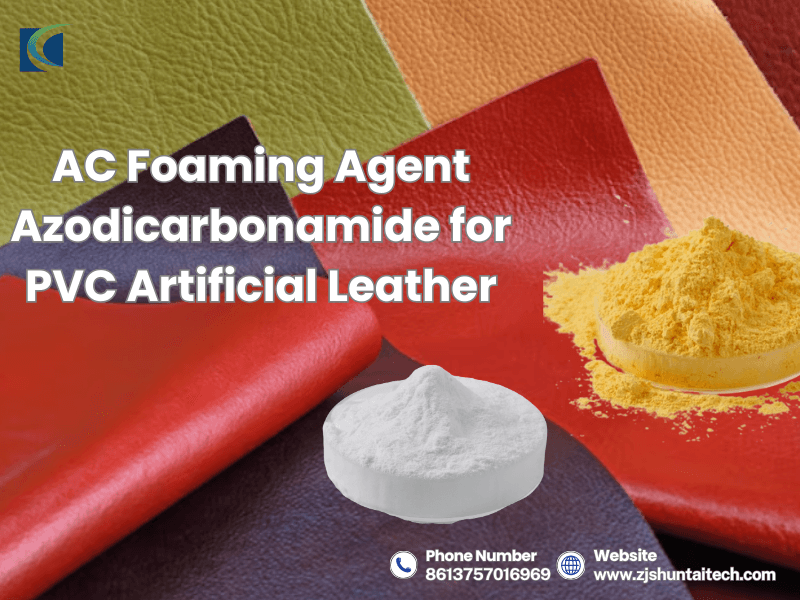
In the chemical and materials industry, foaming agents serve as critical additives driving lightweight and functional upgrades in numerous products. Among these, AC foaming agent azodicarbonamide holds an irreplaceable position in PVC artificial leather production due to its unique properties.As a highly efficient chemical foaming agent, it releases gas under specific conditions, enabling PVC materials to form a uniform, fine-celled structure. This imparts PVC artificial leather with a soft tactile feel, excellent elasticity, and superior sound and heat insulation properties.
Today, leveraging its cost advantages and diverse aesthetic designs, PVC artificial leather finds extensive applications in furniture, luggage, footwear materials, automotive interiors, and numerous other sectors, with market demand continuing to grow.As a core additive in PVC artificial leather production, the quality and application effectiveness of AC foaming agents directly impact the final product's quality and market competitiveness. This article will delve into the fundamental characteristics of AC foaming agents, thoroughly analyze their application essentials and core advantages in PVC artificial leather manufacturing, provide selection and usage recommendations for enterprises, and explore future development trends. This comprehensive overview aims to empower industry professionals to fully understand and efficiently utilize this critical additive.
Why is it the preferred foaming agent for PVC artificial leather?
(1) Chemically Stable and Highly Safe
AC blowing agent, azodicarbonamide, has the chemical formula C₂H₄N₄O₂. It appears as a white or pale yellow powder at room temperature with no distinct odor. Its chemical properties are stable, making it resistant to decomposition or deterioration under normal storage and transportation conditions (avoiding high temperatures, open flames, and strong oxidizing agents). This facilitates long-term stockpiling and use by enterprises.Furthermore, when used within national standards and industry specifications, the gases released upon decomposition of AC blowing agent are primarily nitrogen, carbon dioxide, and trace amounts of ammonia. No toxic or harmful substances are emitted, posing no risk to the production environment or operator health. It also does not adversely affect the subsequent processing or performance characteristics of PVC artificial leather.
(2) High Foaming Efficiency and Uniform Cell Structure
During PVC artificial leather production, AC blowing agent rapidly decomposes and releases substantial gas when heated to specific temperatures (typically 160-200°C). This gas expansion propels PVC melt to form uniform cell structures. Its foaming efficiency significantly surpasses traditional physical blowing agents, generating more gas per unit dosage to achieve efficient PVC material foaming. This effectively reduces product density, minimizes raw material consumption, and lowers production costs for enterprises.
More importantly, AC blowing agent decomposes uniformly, releasing gas at a stable pressure. This creates a consistent, evenly distributed bubble structure within the PVC melt.This uniform cell structure not only imparts a softer, more refined tactile feel to PVC artificial leather but also enhances the material's tensile strength, tear resistance, and elastic recovery properties. It prevents issues like product fragility and coarse texture caused by uneven cell distribution, ensuring the high quality of PVC artificial leather.
(3) Excellent Compatibility with PVC Resin and Easy Processing
AC blowing agent exhibits outstanding compatibility with PVC resin. It disperses uniformly within PVC formulations without agglomeration or sedimentation, facilitating subsequent processing steps such as compounding, calendering, and extrusion.Whether producing soft or semi-rigid PVC artificial leather, AC blowing agent adapts well to varying processing parameters without requiring major modifications to existing production equipment, reducing production adjustment costs for enterprises. Simultaneously, its excellent compatibility prevents surface defects like spotting or uneven grain patterns caused by poor compatibility between additives and resin, enhancing the aesthetic appeal and market acceptance of PVC artificial leather.
Application Process and Key Control Points of AC Foaming Agent in PVC Artificial Leather Production
Application Process: Full Integration from Formulation Mixing to Finished Product Molding
1. Formulation Design and Mixing Stage: Determine the AC foaming agent dosage (typically 1%-5% by weight of PVC resin) based on product requirements (e.g., thickness, density, feel, elasticity), while incorporating other additives such as plasticizers, stabilizers, lubricants, and colorants.All raw materials are added to a high-speed mixer in a specific sequence and blended at a controlled temperature (typically 80-100°C) to ensure uniform dispersion of AC blowing agent and other additives within the PVC resin, forming a stable PVC compound.
2. Melting and Plasticizing Stage: The blended PVC mixture is fed into an internal mixer or open mill. Under high temperatures (140-160°C) and mechanical shear forces, the PVC resin gradually melts and plasticizes, forming a PVC melt with specific fluidity. The AC foaming agent remains stable during this stage without decomposition.
3. Foaming and Molding Stage: The plasticized PVC melt is fed into a calender, extruder, or coating machine. It is processed into films or coatings of specific thickness according to product requirements, then enters the foaming oven.Within the oven, the temperature rises to the decomposition point of the AC foaming agent (160-200°C). The AC foaming agent rapidly decomposes, releasing gas that causes the PVC melt to expand and form a structure with pores, completing the foaming process.
4. Post-Processing Stage: The foamed PVC artificial leather undergoes cooling and setting, embossing, and surface treatments (such as coating, hot stamping, etc.). These post-processing steps ultimately produce finished PVC artificial leather with specific appearance and performance characteristics.
Key Control Points: Core elements ensuring foaming effectiveness and product quality
1. AC Foaming Agent Dosage Control: Insufficient dosage leads to inadequate foaming, resulting in excessive density, hard texture, and failure to meet lightweight and softness requirements. Excessive dosage causes overly large or numerous pores, reducing material strength and increasing susceptibility to damage or deformation. It may also trigger surface defects like bubbles or pinholes due to excessive gas release.Therefore, the AC blowing agent dosage must be precisely calculated and controlled based on product requirements, with adjustments made through small-batch trial production when necessary.
2. Temperature Control: Temperature is a critical factor affecting the decomposition and foaming efficiency of AC blowing agents.During the mixing stage, excessively high temperatures may cause premature decomposition of the AC foaming agent, compromising subsequent foaming. In the foaming and molding stage, low temperatures slow or prevent complete decomposition of the AC foaming agent, resulting in low foaming efficiency and uneven cell structure. Conversely, excessively high temperatures accelerate decomposition too rapidly, causing concentrated gas release that ruptures cells and forms large voids, thereby degrading product quality.Therefore, temperatures must be strictly controlled throughout each processing stage to ensure stability within the appropriate range.
3. Processing Time Control: Both excessively long and short processing times impact foaming effectiveness. During the melting and plasticizing stage, insufficient time leads to incomplete PVC resin plasticization and uneven AC blowing agent dispersion; excessive time may cause thermal aging of raw materials, compromising product performance.During foaming and molding, insufficient time prevents complete decomposition of AC foaming agent, resulting in inadequate foaming; excessive time may cause excessive expansion and rupture of the foam cells. Therefore, processing times for each stage must be reasonably set based on the processing technology and equipment performance to balance production efficiency and product quality.
4. Raw Material Quality Control: Beyond AC blowing agents, the quality of other raw materials—such as PVC resin, plasticizers, and stabilizers—also impacts foaming effectiveness.For instance, uneven molecular weight distribution in PVC resin can cause inconsistent plasticization rates, affecting cell uniformity. Excessive volatility in plasticizers may increase material shrinkage during foaming, compromising product dimensional stability. Therefore, strict quality control of all raw materials is essential. Select high-quality, stable suppliers and conduct regular testing to ensure materials meet production requirements.
Core Advantages of AC Foaming Agent in PVC Artificial Leather Applications
Reducing Production Costs and Enhancing Corporate Profit Margins
As previously mentioned, AC foaming agent offers high foaming efficiency, enabling product lightweighting while reducing PVC resin consumption, thereby directly lowering raw material costs.Taking the production of 1mm-thick soft PVC artificial leather as an example, adding 3% AC blowing agent can reduce product density by approximately 20%. This saves about 200kg of PVC resin per ton of product. At the market price of PVC resin at 8,000 yuan per ton, this translates to a raw material cost savings of 1,600 yuan per ton of product.Additionally, AC foaming agent exhibits excellent compatibility with PVC resin, eliminating the need for additional dispersants. It also imposes minimal requirements on production equipment, requiring no major modifications, thereby further reducing auxiliary production costs and equipment investment. In the current environment of significant raw material price fluctuations and intense market competition, AC foaming agent helps enterprises effectively control costs, enhance profit margins, and strengthen market competitiveness.
Optimizing Product Performance to Meet Diverse Market Demands
As consumer expectations for PVC artificial leather quality continue to rise, the market demands increasingly diverse properties such as tactile feel, elasticity, and durability. By forming a uniform cell structure, AC foaming agent significantly enhances the softness and elasticity of PVC artificial leather, making its texture closer to genuine leather. This meets the demand for high-quality materials in premium furniture, luxury luggage, automotive interiors, and other sectors.Simultaneously, this uniform cell structure imparts excellent sound insulation and thermal insulation properties to PVC artificial leather, expanding its applications in architectural decoration and audio equipment casings. Furthermore, AC foaming agents enhance the product's aging resistance and weatherability, preventing issues like hardening, cracking, and fading during prolonged use. This extends product lifespan and boosts consumer satisfaction.
Aligning with Environmental Trends to Support Sustainable Business Development
In recent years, global environmental awareness has surged, with increasingly stringent eco-friendly requirements for chemical products across nations. The PVC industry faces mounting pressure for environmental upgrades. AC blowing agents decompose without producing toxic or harmful substances, complying with EU regulations like RoHS and REACH. PVC artificial leather produced using AC blowing agents meets domestic and international environmental standards, preventing trade barriers caused by environmental concerns.Simultaneously, AC blowing agents' high foaming efficiency reduces PVC resin consumption, lowering the product's carbon footprint and aligning with the “low-carbon and eco-friendly” development trend. For enterprises, selecting AC blowing agents not only ensures product compliance with environmental requirements but also establishes a positive corporate environmental image, supporting sustainable business development.
AC Foaming Agent Selection Guide and Usage Precautions
Selection Guide: How to Choose High-Quality AC Foaming Agent Products
1. Focus on Product Purity and Impurity Content: High-quality AC blowing agents should have a purity of no less than 98% with minimal impurities. Excessive impurities can impair foaming efficiency and cell uniformity, potentially introducing harmful substances that compromise environmental performance and safety. When purchasing, request suppliers to provide product test reports, paying close attention to indicators such as purity, ash content, and moisture to ensure compliance with relevant standards.
2. Evaluate Particle Size and Size Distribution: The particle size and distribution of AC blowing agents affect their dispersibility within PVC resin. Generally, AC blowing agents with smaller particle sizes (e.g., 10-20μm) and uniform size distribution exhibit better dispersibility, enabling the formation of more uniform cell structures.When selecting products, use equipment like laser particle size analyzers to test particle size, or choose suppliers with a good industry reputation and mature production processes to ensure particle size meets production requirements.
Usage Precautions: Mitigating Risks to Ensure Smooth Production
1. Storage Precautions: Store AC blowing agent in a cool, dry, well-ventilated warehouse, away from fire sources, heat sources, and strong oxidizing agents. Avoid direct sunlight.Storage temperature should be maintained below 30°C (86°F), with relative humidity not exceeding 70%. Additionally, AC foaming agent must be stored separately from other chemicals to prevent chemical reactions from cross-storage. During storage, regularly inspect product packaging integrity to prevent moisture absorption and degradation.
2. Operational Precautions: During raw material mixing, feeding, and related operations, personnel must wear protective equipment such as dust masks and gloves to prevent inhalation of AC foaming agent dust or skin contact. Ensure adequate ventilation in the work area to minimize dust concentration. If dust is accidentally inhaled or skin contact occurs, immediately rinse with copious amounts of water and seek medical attention if necessary.
3. Safety precautions during production: During the foaming and molding stage, oven temperatures are elevated, and AC blowing agent decomposition releases gases. Ensure the oven's ventilation system operates normally to promptly exhaust decomposition gases, preventing gas buildup that could cause excessive pressure or safety incidents. Additionally, regularly inspect the operational status of production equipment, including heating systems, temperature control systems, and transmission systems, to ensure proper functioning and mitigate production risks from equipment failure.
WHY CHOOSE SHUNTAI FOAMING AGENTS?
We offer high-quality Azodicarbonamide/AC Foaming Agents that stand out in the market. Our foaming agents come in a complete range of models (SA1000, SA3000, SA5000, SA6000, SA7000, etc.) with precise specifications—featuring a decomposition temperature of 205±5℃, a gas volume of 225±5ml/g, and fineness ranging from 3-5.5μm to 10-15μm—to meet diverse application needs. They excel in stable performance, remaining stable at room temperature while providing adjustable decomposition temperatures, large gas volumes for efficient foaming, non-toxicity, odorlessness, environmental friendliness, and no corrosion or staining to molds and products. Whether for plastic products (PVC shoe materials, air conditioning insulation pipes, packaging materials), rubber products (shoe soles, sealing strips), or other fields like wallpapers, artificial leather, and automotive components.Additionally, we can supply modified products and blowing agent masterbatch to cater to customized requirements, ensuring you get reliable, high-performance solutions backed by our professional production and R&D capabilities.
AC foaming agent azodicarbonamide, as a key additive in PVC artificial leather production, provides robust support for the lightweight, high-quality, and functional development of PVC artificial leather products through its stable chemical properties, efficient foaming performance, and excellent compatibility.