Amid the plastic industry's shift toward “lightweighting, multifunctionality, and greening,” foaming agents—as core additives for preparing foam products from plastic compounds—directly determine key properties of downstream products such as density, thermal insulation, and shock absorption.With 16 years of expertise in the blowing agent field, Zhejiang Shuntai Rubber & Plastic Technology Co., Ltd. has become the preferred partner for plastic industry clients through its extensive experience in producing AC blowing agents (azodicarbonamide).
Founded in 2008 and headquartered in Quzhou City, Zhejiang Province, Shuntai Chemical is a technology enterprise integrating R&D, production, and sales of blowing agents.The company operates a 12,098-square-meter standardized factory equipped with comprehensive facilities including an ultra-fine grinding workshop, mixing workshop, rubber compounding workshop, specialized laboratories, and a low-temperature finished product workshop. This enables full-process control from raw material screening to finished product testing, ensuring the stability and consistency of every batch.
Since its inception, Shuntai Chemical has consistently focused on foaming requirements in plastics, rubber, and related fields. Leveraging its laboratory's R&D capabilities, the company continuously optimizes AC blowing agent formulations and production processes. Its SA series standard products cover applications from general-purpose to high-precision scenarios. Additionally, Shuntai offers customized modified blowing agents and masterbatch services tailored to client needs. The company has served thousands of plastic processing enterprises, with products widely applied in packaging, construction, automotive, home appliances, and other sectors.
.jpg)
AC foaming agent (Azodicarbonamide) possesses a unique molecular structure and performance parameters, making it an ideal choice for foaming plastic compounds.
(1) Fundamental Chemical and Physical Properties
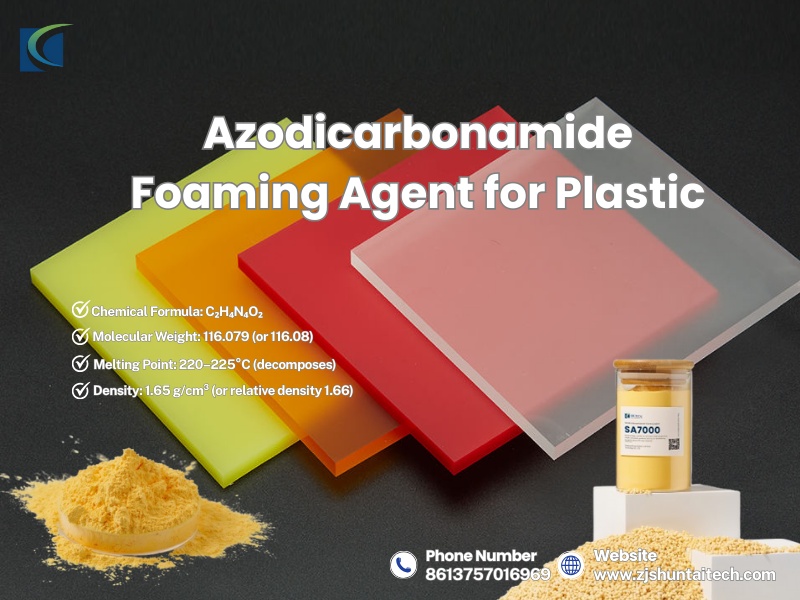
ShunTai AC foaming agent has the chemical formula C₂H₄N₄O₂, with a molecular weight of 116.079 (commonly expressed as 116.08). It appears as a pale yellow powder with a density of 1.65 g/cm³ (relative density 1.66). Its melting point ranges from 220-225°C(decomposition occurs at this temperature). Regarding solubility, the product dissolves in alkaline solutions but is insoluble in gasoline, alcohol, benzene, pyridine, and water. Some research indicates it also exhibits solubility in strong acids and highly soluble organic solvents, a property that ensures good compatibility across various plastic raw material systems.
(2)ShuntaiTech SA Series Models
SA1000 Model: Fineness 10-15μm, decomposition temperature 205±5°C, gas evolution 225±5ml/g. This is a general-purpose product. Its advantage lies in compatibility with various high-temperature rubber and plastic products, particularly suitable for PVC footwear materials, air conditioner insulation pipes, and other applications demanding broad-spectrum blowing agent versatility. It serves as a foundational choice for plastic manufacturers seeking to reduce selection costs.
SA3000 Model: Particle fineness enhanced to 8-10μm, with core parameters consistent with SA1000. Its finer particle size ensures more uniform dispersion in plastic melts, making it suitable for producing plastic products demanding high surface smoothness, such as artificial leather and floor covering materials. It effectively reduces foam pore size variation, enhancing product appearance and texture.
SA5000 Model: Particle fineness further reduced to 6-8μm, designed for high-precision foaming applications. Excels in thin plastic products like wallpaper and carpet backing, forming a dense, uniform foam structure that ensures lightweight properties without compromising tensile strength or tear resistance.
SA6000 Model: With a fineness of 4-6μm, it is designed for intricate plastic components. Suitable for automotive seals, small packaging materials, and similar products, its fine foaming effect enhances cushioning performance and dimensional stability, preventing product deformation caused by uneven foaming.
SA7000 Model: Particle size 3-5.5μm, representing the premium variant of Shun Tai AC foaming agents. Developed specifically for high-precision plastic products like automotive interior components and electronic cushioning pads, it maintains stable foaming even under stringent processing temperatures without generating harmful substances, meeting automotive interior environmental standards.
(3) Stability and Safety
Shun Tai AC Foaming Agent exhibits excellent stability at room temperature without decomposition or deterioration. However, at 120°C, it rapidly decomposes and releases large volumes of nitrogen gas (gas yield: 225±5 ml/g). This characteristic is the core principle enabling plastic foaming.Special caution is required: if the large volume of gas produced during decomposition is trapped in a sealed container, it may cause sudden pressure buildup and explosion. Therefore, sealed high-temperature environments must be strictly avoided during production and storage.
Regarding safety attributes, this product has passed multiple testing certifications and possesses four key characteristics: non-toxic, odorless, non-flammable, and self-extinguishing. It poses no health hazards to production personnel and leaves no harmful residues in plastic products. Compliant with environmental standards such as EU RoHS and China GB/T, it can be safely used in plastic products intended for human contact (e.g., appliance casings, plastic components in children's toys).
Core Advantages of AC Foaming Agent in Plastic Compounds
Compared to conventional foaming agents on the market, Shun Tai Chemical's AC Foaming Agent demonstrates significant competitive advantages in plastic compound applications through five core strengths:
1. Stable Foaming Performance: Ensures Consistent Plastic Product QualityThe decomposition rate and gas release of Shun Tai AC blowing agent are minimally affected by external factors (such as humidity and raw material impurities). It maintains stable foaming effects even across different batches of plastic raw materials. This characteristic effectively prevents issues like density fluctuations and surface blistering caused by uneven foaming, helping businesses improve product yield rates (some customers report yield rates increasing from 85% to over 98%).
2. Environmentally Friendly and Non-Toxic: Aligns with Green Plastic TrendsAs global environmental requirements for plastic products intensify, “non-toxic and odorless” has become a core competitive advantage for foaming agents.ShunTai AC foaming agents produce no toxic gases (such as formaldehyde or heavy metal ions) during production or use. Tested plastic products exhibit no odor, meeting stringent environmental requirements for sectors like food packaging and children's products. For instance, a food packaging company using ShunTai SA3000 successfully passed food contact material safety certifications (e.g., China's GB 4806 standard), enabling its products to enter high-end supermarket channels.
3. High Gas Yield: Reduces Production Costs and Enhances Product LightweightingShuntai AC foaming agents achieve a gas yield of 225±5 ml/g, significantly surpassing conventional foaming agents (approximately 180-200 ml/g). This means enterprises can reduce foaming agent dosage by 15%-20% while maintaining equivalent foaming effects, directly lowering raw material costs.Simultaneously, the higher gas generation enables plastic products to achieve lower densities (e.g., PE foam density can decrease from 0.3 g/cm³ to 0.15 g/cm³), enhancing lightweighting and thermal insulation properties. This makes it suitable for scenarios demanding weight reduction and insulation, such as new energy vehicles and cold chain packaging.
4. Adjustable Decomposition Temperature: Adaptable to Diverse Plastic ProcessingProcessing temperatures vary significantly across plastic materials (e.g., PVC requires 160-180°C, PP requires 180-220°C). ShunTai Chemical can precisely control the decomposition temperature of AC foaming agents within 120-230°C by adjusting formulations, ensuring compatibility with diverse plastic processing requirements.For instance, to meet PP's high-temperature processing demands, customized modified AC blowing agents with decomposition temperatures of 200-210°C can be developed, preventing premature decomposition that compromises melt strength.
5. Non-Corrosive & Non-Staining: Protects Equipment and Product AppearanceShun Tai AC blowing agents leave no corrosive residues upon decomposition, preventing erosion of plastic molds and extending mold service life (typically by 1-2 years). Additionally, the product itself is a pale yellow powder that does not cause pigment migration during foaming, ensuring no discoloration of plastic products. This makes it particularly suitable for manufacturing white and light-colored plastic items (e.g., appliance housings, medical plastic components).
Typical Applications of Shuntai AC Foaming Agents in the Plastics Industry
With diverse formulations and outstanding performance, Shuntai Chemical's AC foaming agents are widely used in mainstream plastics including PVC, PE, PP, and PS, covering six core downstream sectors:
1. Plastic Packaging Materials: Perfect Integration of Lightweighting and Shock Absorption
In express packaging and electronic product cushioning applications, Shun Tai SA1000 and SA3000 grades are used to produce PE and PS foam packaging materials. Their high foaming rate reduces packaging density by 30%-50%. While lightening the weight, the foam structure enhances cushioning performance by 20%, effectively protecting products from impact damage during transportation.An electronics company using PS cushioning pads produced with ShunTai AC foaming agent successfully reduced product shipping damage rates from 5% to 0.5%.
2. Building Plastic Materials: Dual Enhancement of Thermal Insulation and Soundproofing
In the construction sector, ShunTai SA3000 and SA5000 models can be used to produce PVC wallpaper, PP floor covering materials, and PE insulation boards.Taking PE insulation boards as an example, adding AC foaming agent reduces the thermal conductivity from 0.04W/(m·K) to 0.03W/(m·K), improving insulation performance by 25%. Simultaneously, the closed-cell foam structure effectively blocks sound transmission, enhancing sound insulation by 10-15dB, meeting the thermal and acoustic insulation needs of residential and commercial buildings.
3. Automotive Plastic Interiors: Dual Assurance of Environmental Friendliness and Precision
Automotive interiors demand exceptionally high standards for plastic products in terms of environmental friendliness (low VOC) and precision (dimensional stability). Shun Tai's SA5000 and SA7000 grades emerge as ideal solutions.When used in automotive door panels, dashboard cushioning layers, seat back foam, and similar applications, these foaming agents are odorless and meet automotive interior environmental standards. Their fine foaming effect ensures dimensional accuracy (with tolerances controlled within ±0.1mm), preventing assembly issues caused by uneven foaming.Currently, Shun Tai Chemical has partnered with multiple automotive component manufacturers to provide foaming solutions for new energy vehicle interiors.
4. Home Appliance Plastic Components: Balancing Heat Resistance and Cushioning
In home appliances like refrigerators, air conditioners, and washing machines, Shun Tai AC foaming agents (SA1000 and SA3000 models) can be used to produce components such as evaporator insulation sleeves, outer shell cushioning layers, and base vibration damping pads.Its stable high-temperature performance (no decomposition at 100-120°C) meets the long-term heat resistance demands of home appliances, while its cushioning properties reduce vibration and noise during operation. A certain air conditioner manufacturer achieved an 18% improvement in insulation efficiency and a 5% reduction in energy consumption using PVC insulation pipes produced with Shuntai AC foaming agents.
5.Sports Equipment Plastics: Balancing Lightweighting and High Elasticity Plastic components in sports equipment—such as yoga mats, fitness band casings, and ski board cushioning layers—require specific lightweighting and elasticity properties. Shuntai SA3000 and SA5000 models achieve this by controlling foam pore size (100-300μm), enabling reduced product density while maintaining excellent elastic recovery rates (≥85%).For example, a sports equipment manufacturer using ShunTai AC blowing agent to produce PE yoga mats achieved a 20% weight reduction and 15% elasticity increase, significantly enhancing user experience.
6. Cross-linked Polyethylene (XLPE) Foam: The Exclusive Choice for High-End Applications
Cross-linked polyethylene foam, valued for its high-temperature resistance and aging resistance, is widely used in premium packaging, medical protection, and other high-end fields.ShunTai SA1000 is a specialized blowing agent for this foam type. Its decomposition temperature perfectly aligns with XLPE's cross-linking temperature (180-200°C), enabling simultaneous foaming during cross-linking to form a uniform closed-cell structure.The product achieves a tensile strength of up to 1.5 MPa and an elongation at break of ≥300%, significantly outperforming standard PE foams. It is ideally suited for applications such as breathable layers in medical protective suits and packaging for high-end electronic products.
Storage and Transportation Specifications for AC Foaming Agent
To ensure the stable performance and safe use of Shun Tai AC Foaming Agent, strictly adhere to the following storage and transportation requirements:
Storage Specifications
Environmental Control: Store in a warehouse maintained at room temperature (5-30°C), dry conditions (relative humidity ≤60%), and good ventilation. Avoid direct sunlight or proximity to heat sources (e.g., boilers, heaters). Storage temperatures must not exceed 120°C (to prevent premature decomposition).
Container Selection: Use open-top or vented packaging containers (e.g., perforated plastic drums). Sealed containers (e.g., closed metal drums) are strictly prohibited to prevent nitrogen gas accumulation from decomposition, which could cause explosions.
Material Isolation: Store separately from strong acids (e.g., hydrochloric acid, sulfuric acid), strong oxidizing agents (e.g., potassium permanganate), and flammable substances (e.g., alcohol, gasoline). Maintain a minimum distance of 1 meter to prevent chemical reactions that could compromise product performance or cause safety incidents.
Stacking Requirements: Stack products no higher than 2 meters to prevent bottom packaging from rupturing under pressure and causing powder leakage. Additionally, reserve at least 0.5 meters of clearance around stacked areas for ventilation and emergency access.
Transportation Requirements
Transportation Vehicles: Prioritize enclosed trucks with dry, clean cargo compartments. Avoid open-top trucks (to prevent rainwater exposure causing product caking).
Loading/Unloading: Handle with care; never throw or impact packages to prevent damage. Separate and clearly label different product models to avoid mix-ups.
Temperature & Protection: During summer transport, implement sunshade measures (e.g., tarps) to prevent cabin temperatures exceeding 40°C (104°F). Winter transport requires no special insulation but must prevent packaging from freezing or moisture exposure.
Emergency Response: If packaging damage or powder leakage occurs during transport, immediately halt transportation. Transfer the leaked product to a well-ventilated area and cover it with dry sand for collection. Never rinse directly with water (to prevent product clumping and degradation).
Among numerous foaming agent suppliers, ShunTai Chemical stands as the trusted choice for plastics enterprises due to four key advantages:
Technical R&D Capabilities: Continuous Innovation to Meet Industry Demands
Shun Tai Chemical maintains specialized laboratories and R&D teams to optimize foaming agent formulations based on industry trends (e.g., biodegradable plastics, high-temperature engineering plastics). For instance, addressing the low-temperature processing requirements of biodegradable plastics like PLA, we developed a specialized AC foaming agent with a decomposition temperature of 140-160°C, resolving the issue of incomplete decomposition at low temperatures common in traditional agents.
End-to-End Quality Control: Rigorous Oversight from Raw Materials to Finished Products
The company implements a comprehensive quality control system covering “raw material testing - production monitoring - finished product inspection”: Raw materials undergo testing against over 10 criteria including purity and impurity content prior to procurement. During production, product fineness and gas generation are sampled and tested every two hours. Quality inspection reports are issued before finished products leave the factory, ensuring every batch meets standards.
Flexible Customization Services: Tailored to Individual Needs
Beyond standardized SA series products, Shun Tai Chemical offers customized modified AC blowing agents and masterbatch solutions tailored to clients' plastic raw materials, processing techniques, and performance requirements. For instance, our sterile AC blowing agent developed for a medical plastics manufacturer undergoes aseptic processing to meet microbiological standards (total bacteria ≤10 CFU/g).
Comprehensive After-Sales Support: Production Assurance Throughout
Shun Tai Chemical delivers full-cycle support: “Pre-sales selection guidance - In-process technical support - Post-sales issue resolution.” Pre-sales: Professional engineers recommend suitable models based on product requirements. In-process: Technical personnel visit client facilities to guide foaming agent dosage and process parameter adjustments. Post-sales: Product quality issues receive 24-hour response and 48-hour solutions.
Conclusion
As a core additive for
plastic compound foaming, the quality of AC blowing agents directly impacts the performance and market competitiveness of downstream products. With 16 years of expertise in the blowing agent field, Shuntai Chemical drives innovation through technology and quality control. Our SA series AC blowing agents not only meet diverse industry demands in technical parameters and application scenarios but also empower plastic enterprises to achieve product upgrades and cost optimization through eco-friendly, stable, and efficient performance.
Whether for general-purpose plastic packaging or high-precision automotive interiors, whether for standardized product procurement or customized solution requirements, Shuntai Chemical delivers professional, reliable AC foaming agent products and services. Choosing shuntaiTech means partnering with a trusted ally in the plastics industry, jointly advancing the sector toward greener, more efficient, and higher-quality development.