In automotive sealing, building waterproofing, home appliance cushioning, sports equipment, and other fields, EPDM reclaimed rubber sponge has become a mainstream material due to its excellent weather resistance, elasticity, and cost advantages. Among these, the foaming agent serves as a core factor determining sponge performance, directly influencing key product metrics such as density, closed-cell rate, and compression set.
Core Characteristics of EPDM Reclaimed Rubber Sponge
Selecting the appropriate foaming agent requires first understanding the fundamental properties of EPDM reclaimed rubber sponge—its structure and performance requirements directly define the selection parameters for foaming agents.
Structure of EPDM Reclaimed Rubber
EPDM reclaimed rubber is processed from discarded EPDM products, exhibiting a broad molecular weight distribution (typically 10⁴-10⁶) and significant variation in crosslinking density (ranging from 0.5 to 2.0 mmol/cm³ depending on the recycled feedstock).This structural profile imposes “compatibility” requirements on blowing agents: poor compatibility with recycled rubber leads to uneven dispersion; mismatched decomposition rates with crosslinking reactions cause cell collapse.
For instance, low-crosslinked EPDM recycled rubber suits slow-decomposition blowing agents to prevent cell rupture due to insufficient compound strength;while highly crosslinked recycled rubber requires more reactive blowing agents to ensure foaming efficiency.
Performance Requirements for EPDM Sponge
Market demands for EPDM sponge performance are highly segmented: automotive seals require “no brittleness at -40°C, permanent compression deformation ≤15%”; building waterproofing membranes require “UV aging resistance for 5000 hours without cracking, water absorption ≤3%”;Home appliance gaskets require “VOC content ≤100g/L, odor grade ≤3.”
These performance metrics directly dictate foaming agent selection: For low compression set, agents with minimal impact on rubber elasticity are needed; for UV resistance, agents must synergize with EPDM's antioxidant system to prevent accelerated aging from residues.
Fundamental Screening Criteria for Foaming Agents
Based on the above characteristics,
foaming agents must meet three core requirements:
• Compatibility: The difference in solubility parameter (SP value) between the foaming agent and EPDM recycled rubber must be ≤1.5 (EPDM's SP value is approximately 8.0-8.5) to prevent “delamination” during foaming.
• Decomposition Temperature Matching: The peak decomposition temperature of the foaming agent must coincide with the EPDM vulcanization temperature (typically 150-180°C), with a deviation controlled within ±5°C. This prevents “premature foaming” (foaming before vulcanization causing cell deformation) or “delayed foaming” (foaming after vulcanization causing sponge blistering).
• Stable Gas Yield: Gas yield variation within the same batch must be ≤3% to ensure foam density deviation is controlled within ±0.02 g/cm³, meeting mass production requirements.
.png) Precision Parameter Matching for Production
Precision Parameter Matching for Production:
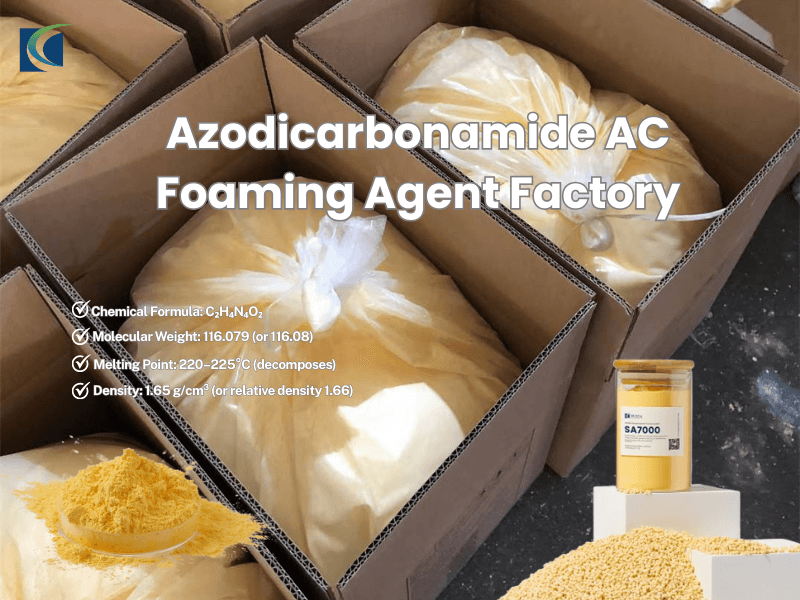
The AC series includes models SA1000, SA3000, SA5000, SA6000, and SA7000, all featuring a decomposition temperature of 205±5°C and high gas yield of 225±5ml/g, meeting gas requirements for high-temperature rubber/plastic processing (e.g., PP/PE products processed at 180-220°C).Particle size ranges from 10-15μm (SA1000) to 3-5.5μm (SA7000), allowing flexible selection based on foam fineness requirements. Coarser grades suit general applications, while finer grades (e.g., SA7000) excel in products demanding uniform bubble distribution, such as wallpaper and synthetic leather.
Stable, Durable, Eco-Friendly & Safe:
Maintains stable performance at room temperature, minimally affected by ambient temperature and humidity, ensuring consistent foaming results across batches. Non-toxic, odorless, and non-corrosive, it avoids contaminating processing molds while posing no harm to humans or the environment. Complies with mainstream environmental standards, eliminating risks of harmful gas emissions during production.
Highly Adjustable for Complex Processes:Decomposition temperature can be tailored through formulation adjustments to match processing cycles of different materials (e.g., synchronous foaming requirements during rubber vulcanization lasting 10-30 minutes). High gas content efficiently achieves product lightweighting while delivering insulation, soundproofing, and shock absorption functions.
Low-Temperature Decomposition for Sensitive Processes:
The NC series (NC-1 to TNC102) features a broad decomposition temperature range (135-195°C), significantly lower than AC foaming agents' 205°C threshold. This meets the low-temperature processing requirements of materials like PVC, TPR, and TPE, preventing high-temperature degradation of substrate properties.Gas yield: 90-130 ml/g. While lower than AC, this is more suitable for micro-foaming applications, enabling precise density control and preventing strength reduction caused by oversized bubbles.
Multi-functional Product Enhancement:
Improves dimensional stability in PVC, PP, PE, ABS, and similar products. Simultaneously enhances whiteness and smoothness, making it particularly suitable for applications demanding high aesthetics like artificial leather and crafts. As an eco-friendly material, production generates no harmful gases, and waste is recyclable, aligning with sustainable development needs.
Balancing Lightweighting and High Strength:
Its low density forms a uniform, fine-cell structure upon foaming, ensuring lightweight products while maintaining strength and toughness. This characteristic makes it highly advantageous for aerospace structural components and automotive shock-absorbing parts, reducing carrier weight while withstanding extreme environments or high-frequency vibrations.
EPDM Recycled Rubber Sponge Foaming Agent Selection
1. Decomposition Temperature
EPDM recycled rubber vulcanization typically relies on peroxide (e.g., DCP) or sulfur systems. The peak vulcanization time must strictly align with the peak decomposition time of the foaming agent.
2. Gas Yield
Gas yield is inversely proportional to sponge density (Formula: ρ≈ρ₀/(1+V×η), where ρ is sponge density, ρ₀ is EPDM recycled rubber density (approx. 1.05 g/cm³), V is gas yield, and η is foaming efficiency).
Note: A higher gas yield is not necessarily better — excessively high gas yields (e.g., >300 mL/g) result in overly thin cell walls, increasing sponge compression deformation (exceeding 20%).
3. Cell Structure Stability
Foaming agent residues directly impact cell wall strength: Ammonia residues from AC foaming agents accelerate EPDM aging, causing cell walls to become brittle and crack at elevated temperatures (e.g., 80°C). While benzene sulfonamide residues from OBSH are stable, they reduce compound elasticity, diminishing rebound performance after prolonged compression.
4. Weather and Medium Resistance
In outdoor or specialized environments (e.g., oil contamination, rainwater), prioritize evaluating the synergistic weather resistance between the blowing agent and EPDM:
• UV Aging Resistance: Select foaming agents with residues free of double bonds and benzene rings (e.g., CO₂ physical foaming agents). Combining these with 2.0–3.0 parts UV absorber (e.g., UV-531) can extend foam UV aging resistance from 3000 hours to over 5000 hours;
• Oil resistance: Avoid foaming agents containing ester residues (e.g., plasticizers in certain compound foaming agents), as these residues are easily extracted by oil, causing cell structure collapse. Recommended alternatives include OBSH or pure AC foaming agents, which maintain volume change within ±3% after 100°C × 24h engine oil immersion.
Application-Specific Selection Strategy
Automotive Sealing Strips: Prioritize Low-Temperature Resistance and Low Compression Set
Automotive sealing strips must maintain elasticity within the -40°C to 80°C temperature range, with compression set (70°C × 22h) ≤15%. They must also meet VOC (≤80g/L) and odor (≤Grade 3) requirements.
Recommended Formulation: OBSH blowing agent (1.5-2.0 parts) + zinc oxide (0.5 parts) + stearic acid (0.3 parts) composite system.
• Advantages: OBSH decomposition residue (benzenesulfonamide) minimally impacts rubber elasticity. Combined with ZnO, it lowers decomposition temperature to 160-170°C, perfectly matching automotive seal vulcanization processes (165°C × 15 min).
• Performance: Low-temperature (-40°C) tensile strength retention ≥80%, compression set ≤12%, VOC content ≤75g/L, meeting standards of OEMs like Volkswagen and Toyota.
Building Waterproofing Membranes: Prioritize Water Resistance and UV Aging Resistance
Exposed to outdoor conditions long-term, building waterproofing membranes must meet requirements: “5000h UV aging resistance without cracking, water absorption ≤3%, heat resistance (80°C) without flow,” while maintaining reasonable cost control.
Recommended formulation: AC foaming agent (2.0-2.5 parts) + Antioxidant 1010 (0.5 parts) + UV-531 (0.3 parts) system.
• Advantages: AC foaming agent offers low cost (approx. 15 RMB/kg). Adding antioxidants and UV absorbers neutralizes aging risks from its alkaline residues.
• Performance: After 5000h UV aging, tensile strength retention ≥70%, water absorption ≤2.5%, no flow at 80℃×5h heat resistance, compliant with GB 18173.1-2014.
Home Appliance Seals: Low Odor, Eco-Friendly Priority
Seal gaskets for appliances like refrigerators and air conditioners must meet “odor grade ≤3, VOC ≤100g/L, and RoHS 2.0 restricted substance compliance,” with fine cell structure (diameter ≤200μm) to ensure sealing performance.
Recommended formulation: CO₂ physical blowing agent (pressure 12-14MPa) + nano CaCO₃ (1.0 parts).
• Advantages: CO₂ leaves no chemical residues, reduces odor level to below Grade 2, and achieves VOC ≤ 50g/L. Nano CaCO₃ acts as a nucleating agent, controlling cell diameter to 100-150μm and improving sealing performance by 15%.
• Outcomes: Complies with EU RoHS 2.0 and China GB/T 18883-2022 standards; mass-produced for home appliance manufacturers including Midea and Gree.
Sports Equipment Cushioning Components: Prioritize High Elasticity and Impact Resistance
Products like yoga mats and treadmill cushioning layers require “tensile rebound rate ≥90%, impact absorption ≥40%” with no deformation during prolonged use.
Recommended formulation: AC+OBSH composite blowing agent (AC 1.0 parts + OBSH 0.8 parts) + silica (5.0 parts).
• Advantages: AC delivers high gas generation rate (ensuring low density), OBSH enhances elasticity, and silica strengthens cell wall integrity;
• Results: Foam density 0.25-0.3 g/cm³, tensile rebound rate ≥92%, impact absorption ≥45%, meeting EN 14411-2008 sports equipment safety standards.
Partner with ShunTai for Customized Foaming Agents Solutions
Whether you require high-temperature universal AC foaming agents, low-temperature precision NC foaming agents, or customized modifications, Zhejiang Shuntai delivers precisely tailored solutions based on your product materials, processing techniques, and performance requirements. We not only provide premium products but also offer dedicated team support throughout the entire process—from selection and testing to mass production—helping you mitigate risks and enhance efficiency. Contact us today and let Shuntai foaming agents become the powerful foundation for your product upgrades and production capacity expansion!